










2026 fixed-income outlook: finding opportunity in uncertainty
The past year was anything but predictable for bond investors. As we look ahead to 2026, our outlook remains steady, and we believe there are compelling reasons to be optimistic about the role core and core-plus fixed income can play in a diversified portfolio.







After a year marked by market swings and shifting headlines, one thing stands out: the U.S. economy has demonstrated remarkable resilience. Despite ongoing uncertainty and a volatile interest rate environment throughout 2025, steady growth and solid corporate fundamentals have kept corporate America on firm footing. Companies are heading into 2026 with healthy earnings, a reassuring sign for investors.
Yet, beneath this resilience, the job market is softening. Hiring has slowed, and demand for workers isn’t as robust as it was a year ago. Why does this matter for bond investors? As part of its dual mandate, the U.S. Federal Reserve (Fed) pays close attention to employment trends when deciding on interest rate policy. If the labor market continues to soften, the Fed may have more flexibility to cut interest rates in the coming year.
Currently, the market is pricing in several rate cuts by the end of 2026, but the exact number and timing will depend on how both employment and inflation data evolve. As history has shown, central bank decisions are notoriously difficult to predict. That’s why we believe strategies that focus on taking advantage of changes in the shape of the yield curve could be a promising way to capture opportunities in the year ahead.
How has the yield curve shifted over the past year?
One of the most notable developments of 2025 has been the continued steepening of the yield curve, resulting from a growing divergence between short-term and long-term interest rates. For bond investors, this matters because a steeper yield curve can create attractive opportunities, particularly for those focused on intermediate maturities.
The yield curve has been steepening since mid-2023
10-year U.S. Treasury minus 2-year U.S. Treasury (constant maturity)
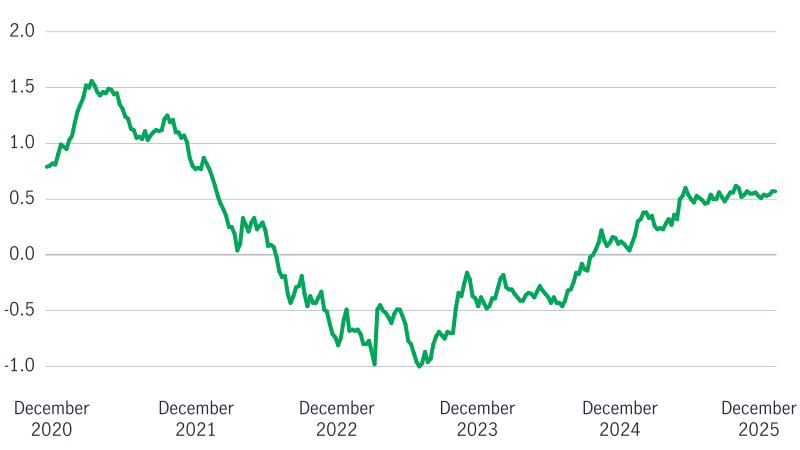
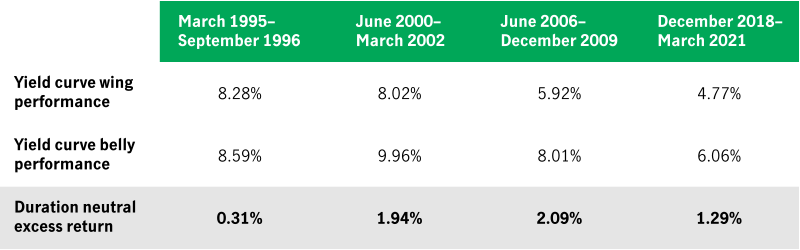
Historically, intermediate-term bonds have provided a sweet spot when the yield curve is steepening, striking a balance between risk and reward. While it’s impossible to know exactly what the Fed will do next, our base case is that this steepening will continue, creating opportunities for investors focused on the middle, or 5- to 7-year portion of the yield curve.
Intermediate-term bonds have typically outperformed when the yield curve steepens
What is the outlook for corporate bonds in 2026?
Corporate bond fundamentals remain solid, with many companies demonstrating resilience through steady earnings and strong balance sheets. Still, if interest rates move lower and the broader economic outlook weakens, we could see credit spreads, or the difference between corporate bond yields and government bond yields, begin to widen. This often happens even when companies themselves are in good financial shape, as investors reassess the additional yield they require to take on more risk in a slowing environment.
Credit spreads tend to widen during recessions
Basis points (bps)
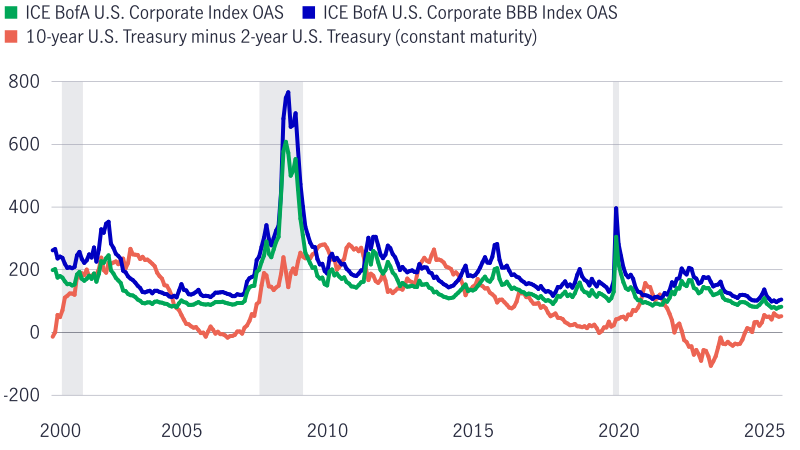
If the economy slows and spreads widen, it will be crucial to look beyond headline yields and dig deeper into what’s really driving value in the corporate bond market. Not all sectors or companies will perform the same, so careful sector rotation and security selection can make a meaningful difference. In times like these, active management can add value by identifying issuers that the market may have overlooked or penalized, even when their fundamentals remain strong.
How can an allocation to mortgage-backed securities potentially benefit fixed-income investors?
Agency mortgage-backed securities (MBS) have been a bright spot in fixed income. These bonds are backed by pools of home loans and supported by government-sponsored entities (GSEs), such as Fannie Mae and Freddie Mac. Over the past year, this sector has delivered strong results: the Bloomberg U.S. MBS Index returned 8.4% through the end of November, outpacing the Bloomberg U.S. Aggregate Bond Index’s 7.5% return.1 This performance has been driven by lower interest rate volatility and yields that are competitive with those of corporate bonds.
Some advantages offered by agency MBS include their high degree of liquidity along with minimal credit risk. This combination makes them an appealing option for investors seeking stability within their fixed-income portfolios. At a time when most fixed income sectors are trading at historically tight spreads, single-family agency MBS stand out for both their strong liquidity and attractive yields.
Here too, security selection plays a crucial role. While many homeowners currently have significant equity, falling interest rates could encourage more refinancing. This increases what’s known as “prepayment risk”—the possibility that loans are paid off early, which can alter the expected cash flows from these bonds. Carefully managing this risk is essential to capturing the best opportunities in the agency MBS market.
GSE reform remains a key topic in the market, but even if privatization occurs, the implicit government guarantee is expected to persist, providing a backstop for the sector. Recent policy developments have also put the spotlight on GSEs as potential major buyers of agency MBS. If GSEs expand their buying, it could help stabilize spreads during periods of volatility and support mortgage rates. However, such moves would likely be highly targeted and conditional, focused on stabilizing the market during acute dislocations. It’s important to note that while this optionality is back on the radar, the market is not yet pricing in significant GSE buying.
Our view on the year ahead
Looking ahead, the outlook for high-quality bonds remains constructive. Even in a challenging environment, current yields remain above their historical averages, offering the potential for mid-single-digit gains and presenting attractive risk-adjusted opportunities for long-term investors.
By focusing on quality, maintaining discipline, and adapting to changing conditions, bonds can continue to play a valuable role in a diversified portfolio. In short, while markets may remain dynamic, there are plenty of reasons to feel optimistic about fixed income.
1 Bloomberg, as of November 30, 2025.
Index definitions
Index definitions
Bloomberg U.S. 5–7 Year Treasury Bond Index
The Bloomberg US Treasury: 5-7 Year Index measures US dollar-denominated, fixed-rate, nominal debt issued by the US Treasury with 5-6.9999 years to maturity. It is not possible to invest directly in an index.
Bloomberg U.S. 1–3 Year Treasury Bond Index
The Bloomberg U.S. 1–3 Year Treasury Bond Index tracks the performance of the U.S. government bond market and includes public obligations of the U.S. Treasury with a maturity between one and three years. It is not possible to invest directly in an index.
Bloomberg U.S. 25+ Year Treasury Bond Index
The Bloomberg Barclays US Treasury 25+ Year Index measures the performance of US dollar-denominated, fixed-rate, nominal debt issued by the US Treasury with remaining years to maturity of at least 25 years. It is not possible to invest directly in an index.
Important disclosures
Important disclosures
This material is for informational purposes only and is not intended to be, nor shall it be interpreted or construed as, a recommendation or providing advice, impartial or otherwise. Manulife John Hancock Investments and our representatives and affiliates may receive compensation derived from the sale of and/or from any investment made in our products and services.
The opinions expressed are those of the author(s) and are subject to change as market and other conditions warrant. No forecasts are guaranteed. Past performance does not guarantee future results. This commentary is provided for informational purposes only and is not an endorsement of any security, mutual fund, sector, or index.
Investing involves risks, including the potential loss of principal. These products carry many individual risks, including some that are unique to each fund. Fixed-income investments are subject to interest-rate and credit risk; their value will normally decline as interest rates rise or if an issuer is unable or unwilling to make principal or interest payments. Mortgage- and asset-backed securities may be sensitive to changes in interest rates and may be subject to early repayment and the market’s perception of issuer creditworthiness.
MF5063058
JHS-854902-2025-12-17