









Stable value funds: a cornerstone for capital preservation in retirement plans
Stable value funds have historically proven to be a reliable choice for qualified investors focusing on seeking capital preservation with reliable income. Discover how these funds can potentially help strengthen retirement portfolios through their unique structure.





When it comes to guiding retirement strategies, selecting appropriate capital preservation vehicles that offer a reliable income stream is an essential factor for any investor to consider in their retirement planning strategy. This is increasingly relevant at a time when monetary policy is expected to ease, and interest rates are likely to decline.
Among the available options, stable value funds offer a blend of stability and income potential. With $858 billion1 invested in stable value funds, these investments provide a prudent option for those seeking to safeguard retirement assets.
What is a stable value fund?
A stable value fund is a conservative investment option in retirement plans that seeks to combine capital preservation with steady income through a portfolio of high-quality bonds wrapped by insurance contracts. These funds maintain a stable net asset value while crediting interest, offering lower volatility than bond funds with returns typically exceeding money market funds.
Stable value funds are among the popular investment options in defined contribution plans, as they're designed to seek preservation of principal and steady returns, primarily through investments in investment-grade short- to intermediate-term fixed-income securities.
The presence of synthetic and/or traditional guaranteed investment contracts (GICs) issued by insurance companies and/or banks is what sets stable value funds apart from traditional investments. These contracts allow transactions to occur at book value—typically a net asset value of $1 per share—helping to preserve the invested principal. Book value is determined by the amount invested, plus interest earned, minus expenses. The applied credit to the principal is set by what's called the crediting rate.
The benefit of GICs, beyond preserving capital, is that, depending on the performance of the underlying investments in the portfolio, these contracts allow gains or losses to be amortized over the portfolio's duration, which helps smooth volatility.
Smoothening volatility
How stable value funds achieve steady growth through crediting mechanisms
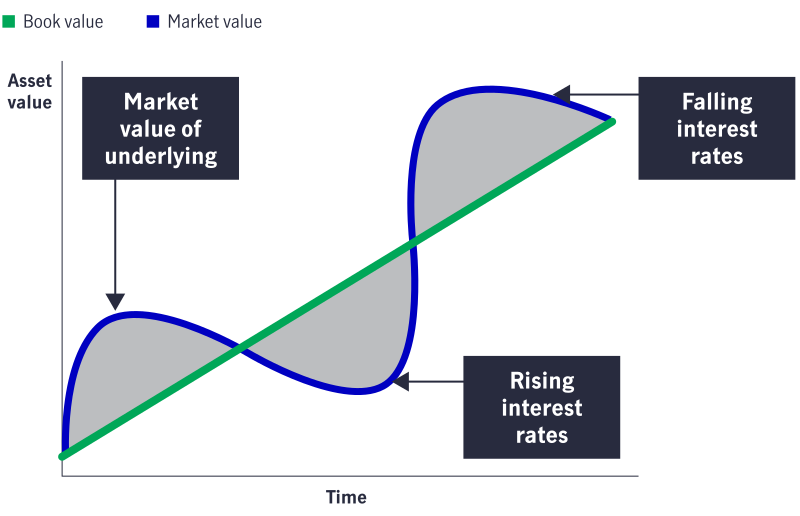
“Stable value funds are structured to seek returns akin to short- to intermediate-term bonds, with minimal volatility regardless of market conditions.”
Types of stable value funds
Stable value investments, like other investment strategies, offer a diversified set of product structures and underlying investments. The two most popular categories of stable value funds are: insurance accounts and commingled or pooled funds. The major differences among the two are that they have different fee structures, plan-level withdrawal provisions, and guaranteed minimum interest rates, which are unique to each stable value fund.
Insurance company account: This type of stable value fund is structured through an agreement between the insurance company and a plan sponsor, typically in the form of a group annuity contract. Under the agreement, the insurance company credits participant book value account or contract balances with a guaranteed rate, i.e., the crediting rate. It also maintains a constant, daily per share price for transactions and provides daily liquidity for participant-level transactions. A plan’s assets are invested in the insurance company’s general account, and the insurance company typically earns its revenue through the difference between investment returns and the crediting rate after expenses.
If a plan’s assets are invested alongside the insurance company’s other general account assets, the account is referred to as a general account stable value product.
Pooled stable value fund: A pooled or commingled stable value fund is made up of a portfolio of bonds (which may be held in a commingled trust or in an insurance company’s separate account) that use synthetic GICs issued by insurance companies or banks. Similar to an insurance company account, a pooled fund pays interest through the crediting rate and allows for daily purchases and sales at a fixed price. One distinct difference is that, unlike insurance company accounts, commingled stable value funds use a standardized crediting rate formula to determine the interest credited to plan and participant accounts. The standardized formula uses the portfolio yield, duration and market-to-book value ratio as its primary inputs to calculate the crediting rate.
Stable value funds and interest rates
The prices and yields of the underlying fixed income securities held in these portfolios have an inverse relationship—when interest rates decline, the market value of a bond portfolio will typically increase and conversely, when interest rates rise, typically the market value of the underlying bonds will fall. However, not every bond or capital preservation fund responds the same way—the longer the duration of the underlying security, the more sensitive its value is to interest rate changes.
The duration of a stable value portfolio will vary based on the manager and product type; however, softening volatility remains one of the hallmarks of a stable value fund.
What is the difference between a stable value fund and a money market fund?
Both stable value and money market funds aim to preserve capital in retirement portfolios. However, they employ different approaches to achieve their investment objective. Money market funds are typically limited to investing in high-quality fixed-income securities with maturities of under one year. Yields on money market funds are therefore more sensitive to changes in short-term interest rates.
In contrast, stable value portfolios have the flexibility to invest in fixed-income securities across various sectors, durations and credit qualities. Aside from the most recent three-year period, the investment flexibility permitted within a stable value portfolio has historically resulted in stable value funds offering higher yields relative to money market funds.
Historically, stable value has outperformed in risk and return
15-year returns and standard deviation (%)
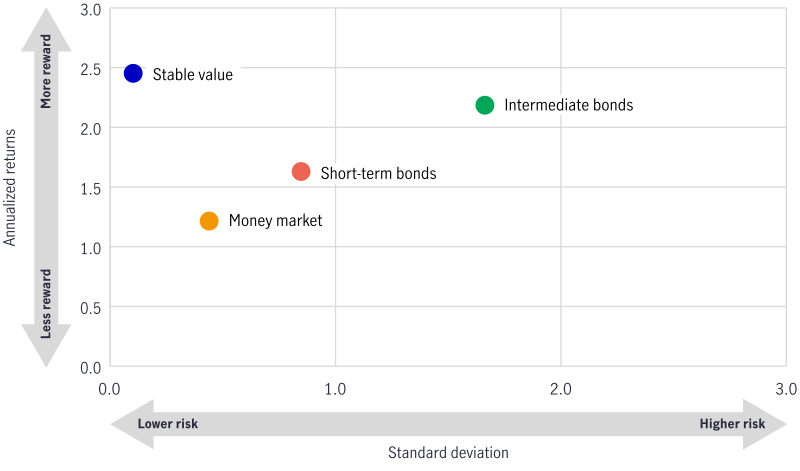
Where stable value fits in the capital preservation landscape
Combining the income potential of intermediate-duration bonds with the security of a GIC, stable value funds aim to blend the benefits of traditional market-based investments with the safety of an insurance-backed product.
Learn more about Manulife John Hancock Investments’ stable value lineup.
1 Stable Value Investment Association, as of 6/30/25.
Index definitions
Index definitions
Stable value is represented by the Morningstar Collective Investment Trust (CIT) Stable Value (SV) Index, part of the Morningstar SV CIT universe, which is an equal-weighted total return average across all participating funds and represents approximately 75% of the SV pooled funds available to the marketplace. Money market is represented by the FTSE 3-Month U.S. Treasury Bill Index, which tracks the performance of the most recent three-month U.S. Treasury bill issues. Ultra-short bonds are represented by the Bloomberg U.S. Short Treasury 9–12 Month Index, which tracks the performance of U.S. Treasury bills, notes, and bonds with up to, but not including, 12 months to maturity. Short-term bonds are represented by the Bloomberg U.S. 1-3 Year Treasury Bond Index, which tracks the performance of the U.S. government bond market and includes public obligations of the U.S. Treasury with a maturity between one and three years. Intermediate bonds are represented by the Bloomberg U.S. Aggregate Bond Index, which tracks the performance of U.S. investment-grade bonds in government, asset-backed, and corporate debt markets. It is not possible to invest directly in an index. Standard deviation is a statistical measure of the historic volatility of a portfolio. It measures the fluctuation of a fund's periodic returns from the mean or average. The larger the deviation, the larger the standard deviation and the higher the risk. Past performance does not guarantee future results.© 2026 Morningstar. All Rights Reserved. The information contained herein: (1) is proprietary to Morningstar and/or its providers; (2) may not be copied or distributed; and (3) is not warranted to be accurate, complete, or timely. Neither Morningstar nor any of its content providers are responsible for any damages or losses arising from any use of this information.
Important disclosures
Important disclosures
Duration measures the sensitivity of the price of bonds to a change in interest rates. Diversification does not guarantee a profit or eliminate the risk of a loss.
Stable value portfolios typically invest in a diversified portfolio of bonds and enter into wrapper agreements with financial companies to prevent fluctuations in their share prices. Although a portfolio will seek to maintain a stable value, there is a risk that it will not be able to do so, and participants may lose their investment if both the fund's investment portfolio and the wrapper provider fail.
This information does not constitute an offer to sell units of any collective investment trust (“CIT”) and the trust is not soliciting offers to buy units of the CIT at any time in any jurisdiction where the offer or sale is not permitted. Units of a CIT are only offered to eligible qualified employee benefit plans in the sole discretion of the trustee. All information contained herein is qualified in its entirety by information contained in each CIT’s offering documents. An investor should consider a CIT’s investment objectives, risk, charges and expenses carefully before investing. Please read the offering documents, including an Offering Memorandum, Declaration of Trust, Participation Agreement and/or Fund Declaration, as applicable, copies of which are available to qualified investors upon request from John Hancock Trust Company or Global Trust Company (John Hancock Stable Value Fund). The trust document may only be available in English.
John Hancock CITs (except John Hancock Stable Value Fund Collective Investment Trust) are maintained and distributed by John Hancock Trust Company, a New Hampshire non-depository trust company. The John Hancock Stable Value Fund Collective Investment Trust, which is maintained by Global Trust Company, the fund’s trustee, a non-depository trust company organized under the laws of the State of Maine. John Hancock Investment Management Distributors LLC acts as the placement agent for Class I shares of the John Hancock Stable Value Fund Collective Investment Trust. John Hancock Investment Management Distributors LLC is a broker-dealer registered with the U.S. Securities and Exchange Commission and a member of the Financial Industry Regulatory Authority, Inc., and SIPC.
The CITs are offered through unaffiliated and affiliated retirement plan recordkeeping platforms. John Hancock Trust Company is affiliated with John Hancock Retirement Plan Services LLC, which offers administrative and/or recordkeeping services to sponsors and administrators of retirement plans. The Trust is also offered through group annuity contracts and recordkeeping agreements issued by John Hancock Life Insurance Company (U.S.A.), Boston, MA (not licensed in NY), and John Hancock Life Insurance Company of New York, Valhalla, NY.
John Hancock Trust Company
197 Clarendon Street, Boston, MA 02116 800-225-6020
Global Trust Company
2 Gill Street #2600, Woburn, MA 01801 781-970-5034
It is your responsibility to select and monitor your investment options to meet your retirement objectives. You should review your investment strategy at least annually. You may also want to consult your own independent investment or tax advisor or legal counsel.
The content of this document is for general information only and is believed to be accurate and reliable as of the posting date, but may be subject to change. It is not intended to provide investment, tax, plan design, or legal advice. Please consult your own independent advisor as to any investment, tax, or legal statements made.
CIT5230485 02/26