








Asset allocation views: positioning in an uneven environment
With equities posting strong gains and earnings expectations remaining resilient, our Q3 market outlook stays constructive on risk assets, while maintaining a focus on diversification and selective opportunities amid ongoing inflation and geopolitical uncertainty.


2026 has so far been defined by resilient economic growth, strong corporate earnings, and robust performance from risk assets. Those trends remained firmly in place during the second quarter, with global equities posting double-digit gains across most major markets. Fixed income markets, however, painted a more mixed picture, with bond returns remaining muted amid increasingly hawkish signals from central banks and persistent inflation concerns.
The quarter was also marked by several notable developments. Geopolitical tensions in the Middle East, which had weighed heavily on sentiment earlier in the year, largely eased and helped support a stronger risk backdrop. Meanwhile, the U.S. Federal Reserve (the Fed) entered a new era of leadership, bringing changes in communication style and introducing fresh uncertainty around the future path of monetary policy.
In our market outlook for the year ahead, we continue to see a constructive environment for investors, although one where many markets have already priced in a fair amount of good news. In our view, the foundations of the economic expansion remain intact. Labor markets are healthy, consumer spending remains resilient, and business investment continues to provide support. While inflation remains a key risk, recent signs of moderation suggest policy rates may be near their peak across much of the developed world.
In an environment where uncertainty persists but economic fundamentals remain supportive, we believe investors should focus on the structural forces shaping markets rather than attempting to forecast every short-term headline. Maintaining diversification, staying disciplined, and identifying areas where leadership is broadening will be key as we move through the second half of the year.
Positioning for what’s next
While we remain constructive on risk assets, the market backdrop is becoming increasingly nuanced. Elevated expectations, evolving monetary policy, and geopolitical uncertainty all require a balanced approach. At the same time, several powerful themes continue to create opportunities across regions and asset classes.
In our view, these are the key themes for Q3 2026:
- Central banks turned hawkish—is another reset likely?
Inflation continues to be the most important factor influencing markets. While recent data suggest price pressures may be gradually easing, central banks remain cautious and unwilling to declare victory too early. This has contributed to continued volatility in fixed income markets and a more hawkish tone from policymakers. The recent leadership transition at the Fed adds another layer of uncertainty, particularly as the central bank explores changes to its communication framework. While policy rates may be near their peak, investors can expect volatility as markets adjust to evolving expectations around the path of future rate cuts. - Headwinds persist, but tailwinds dominate
The AI theme remains one of the most important structural drivers of global markets. What began as enthusiasm around a new technology has evolved into a broad-based investment cycle spanning semiconductors, computing infrastructure, data centers, and enterprise adoption. Importantly, the benefits are becoming more widespread across industries and regions. We continue to see significant opportunities among companies enabling AI adoption, as well as businesses that stand to improve productivity and profitability through AI integration. The ongoing buildout of AI-related infrastructure remains a meaningful source of earnings growth and capital investment. - Geopolitical fragmentation: a persistent market reality now
While tensions in the Middle East eased for a while during the second quarter, geopolitical fragmentation remains an enduring characteristic of the investment landscape. Supply chains, trade relationships, and capital flows continue to adjust to a more fragmented global environment. Rather than viewing these developments as isolated events, we see them as part of a longer-term trend that investors will need to navigate. Periodic conflicts are likely to remain a source of market volatility, reinforcing the importance of diversification and portfolio resilience.
Portfolio positioning highlights
Overall, we remain modestly overweight equities. Economic fundamentals continue to hold up well, corporate earnings expectations remain strong, and the AI investment cycle continues to support growth across portions of the global economy. At the same time, we recognize that valuations in some markets have become more demanding, which argues for a balanced and selective approach.
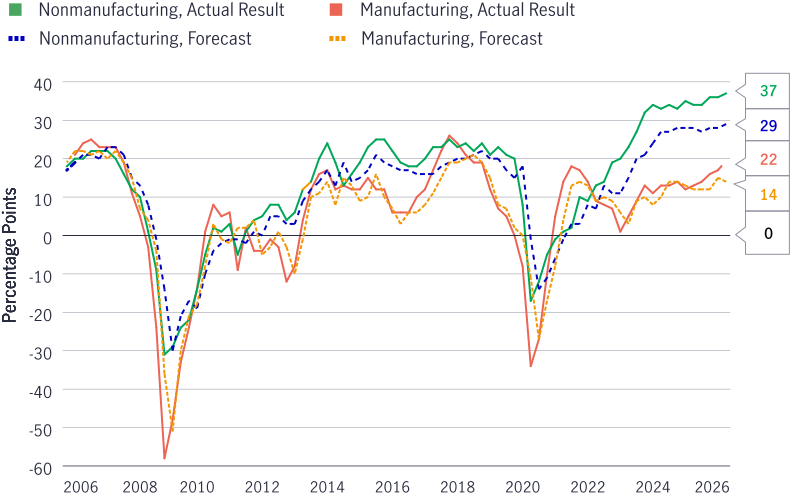
Within equities, we see attractive opportunities in U.S. mid- and small-cap stocks. These companies continue to trade at meaningful valuation discounts relative to large-cap peers, while also showing improving earnings and technical momentum. Outside the United States, we remain attracted to Japan and the broader Asia-Pacific region, where companies are benefiting from strong connections to AI-related supply chains and infrastructure spending.
Japan: TANKAN Business Survey, large enterprises
We also continue to favor commodities as an important portfolio diversifier. Although commodity markets have experienced periods of volatility, we believe they remain valuable for their diversification benefits and potential to help mitigate certain macroeconomic risks.
In fixed income, we remain mindful of ongoing volatility created by inflation and shifting monetary policy expectations. As a result, diversification across asset classes remains an important consideration.
As we move through the second half of the year, we believe investment success will continue to depend on maintaining discipline, avoiding reactions to short-term headlines, and staying focused on a well-diversified portfolio designed to participate in a broader set of opportunities as market leadership continues to expand.
For more details, read the latest asset allocation views from our Multi-Asset Solutions Team.
Important disclosures
Important disclosures
Investing involves risks, including the potential loss of principal. Financial markets are volatile and can fluctuate significantly in response to company, industry, political, regulatory, market, or economic developments. The information provided does not take into account the suitability, investment objectives, financial situation, or particular needs of any specific person.
All overviews and commentary are intended to be general in nature and for current interest. While helpful, these overviews are no substitute for professional tax, investment or legal advice. Clients and prospects should seek professional advice for their particular situation. Neither Manulife Wealth and Asset Management, nor any of its affiliates or representatives (collectively “Manulife WAM”) is providing tax, investment or legal advice.
This material is intended for the exclusive use of recipients in jurisdictions who are allowed to receive the material under their applicable law. The opinions expressed are those of the author(s) and are subject to change without notice. Our investment teams may hold different views and make different investment decisions. These opinions may not necessarily reflect the views of Manulife WAM. The information and/or analysis contained in this material has been compiled or arrived at from sources believed to be reliable, but Manulife WAM does not make any representation as to their accuracy, correctness, usefulness, or completeness and does not accept liability for any loss arising from the use of the information and/or analysis contained. The information in this material may contain projections or other forward-looking statements regarding future events, targets, management discipline, or other expectations, and is only current as of the date indicated. The information in this document, including statements concerning financial market trends, are based on current market conditions, which will fluctuate and may be superseded by subsequent market events or for other reasons. Manulife WAM disclaims any responsibility to update such information.
Manulife WAM shall not assume any liability or responsibility for any direct or indirect loss or damage or any other consequence of any person acting or not acting in reliance on the information contained here. This material was prepared solely for informational purposes, does not constitute a recommendation, professional advice, an offer or an invitation by or on behalf of Manulife WAM to any person to buy or sell any security or adopt any investment approach, and is no indication of trading intent in any fund or account managed by Manulife WAM. No investment strategy or risk management technique can guarantee returns or eliminate risk in any market environment. Diversification or asset allocation doesn’t guarantee a profit or protect against the risk of loss in any market. Unless otherwise specified, all data is sourced from Manulife WAM. Past performance does not guarantee future results.
This material has not been reviewed by, and is not registered with, any securities or other regulatory authority, and may, where appropriate, be distributed by Manulife WAM and its subsidiaries and affiliates. Manulife WAM is the global investment, financial advice, and retirement plan services segment of Manulife Financial Corporation.
© 2026 by Manulife Wealth and Asset Management. All rights reserved. The statements and opinions expressed in this article are those of the author. Manulife WAM cannot guarantee the accuracy or completeness of any statements or data.
5768546 7/26