




Building a UMA-centered practice: key decisions and considerations
A UMA conversion can offer planning, reporting, and operational advantages, but it can also introduce new client questions, platform constraints, and ongoing governance requirements. We explore what advisors should keep in mind.


As advisors evaluate moving clients from commission-based accounts to fee-based relationships, unified managed accounts (UMAs) are often considered as a way to consolidate portfolio management and standardize implementation. In many cases, the conversion process is most effective when it's treated as a change in service model and workflow rather than simply an account type change. Ultimately, the transition hinges on three key considerations: communicating value, implementing scalable portfolio solutions, and leveraging the platform’s capabilities to enhance the client experience.
How should you communicate the value of a fee-based relationship?
When clients move from a commission-based structure to a wrap-fee UMA, the cost of advice and portfolio management typically becomes more explicit and is discussed more frequently. This underscores the importance of clearly describing what the wrap fee covers, which may include portfolio construction, manager and vehicle selection, trading, rebalancing, reporting, and any tax-aware tools or overlays included in the offering.
The conversion process also provides an opportunity for advisors to articulate how their approach differs from other fee-based providers. That differentiation may stem from research and due diligence, trading implementation, portfolio construction, tax management, or a disciplined rebalancing process. Without a clear explanation of both the services and the process, clients may focus primarily on the fee rather than the overall value delivered. The key is to view the UMA account as the single solution endpoint with a clearly articulated value proposition built around it.
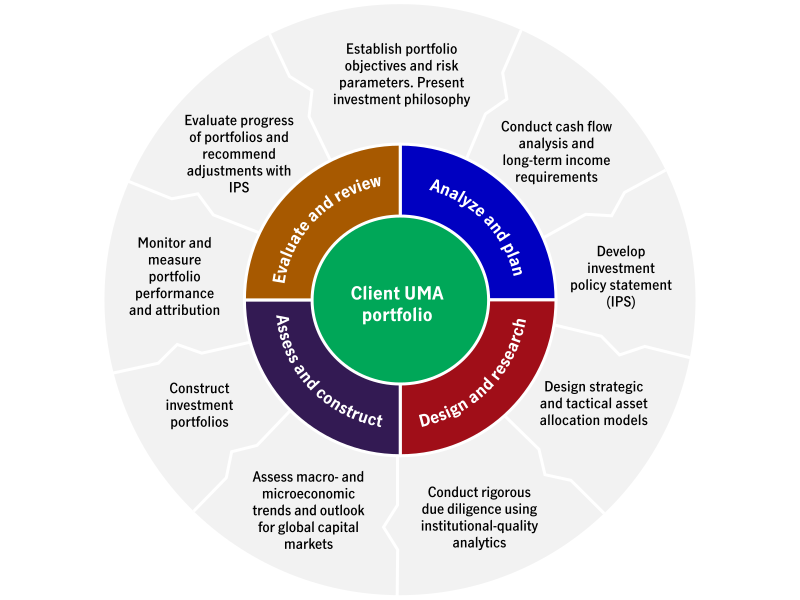
Communicating the value of a UMA portfolio
How can you build scalable portfolios without losing personalization?
UMAs can support consistency across client portfolios, but results depend on model design and implementation discipline. Advisors often benefit from evaluating whether their models are suitability-aligned, easy to update, and supported by tools such as block trading or centralized model changes.
A tiered structure is one approach advisors use to maintain consistent portfolio objectives while adjusting implementation based on client AUM. Higher-AUM households may be implemented with separately managed accounts (SMAs) or additional investment sleeves, while lower-AUM households may use exchange-traded funds (ETFs) or mutual funds to achieve similar exposures with lower account minimums. This can help maintain consistency while providing flexibility where appropriate, creating an opportunity for forward-looking investment managers. Those who offer a single strategy across SMA, ETF, and mutual fund vehicles may be able to provide advisors with an efficiency advantage.
Personalization remains an important consideration as well. Clients may have investment restrictions, tax-management needs, concentrated positions, or legacy holdings that may not have a place within the UMA structure. While some assets or services may remain outside the account, the overall allocation and planning process can still be managed in a coordinated manner. Advisors often address this by maintaining a separate account for securities that aren't appropriate for the UMA, while requesting aggregated quarterly reporting that includes both when conducting client reviews. The ability to balance customization with scalability is often a primary advantage of a UMA-based practice.
How should you leverage technology and operations to enhance the client experience?
Beyond portfolio implementation, UMA platforms can provide enhanced reporting, transparency, and operational efficiency. Advisors typically determine review frequency, whether reporting should be customized based on client preferences, and how suitability or investment policy considerations are incorporated into client discussions.
Rebalancing may also become more systematic within a UMA framework, depending on platform features and advisor processes. Clarifying whether rebalancing is automated or manual, how it's triggered, and how it supports a client’s objectives can help establish expectations and reinforce portfolio discipline. Rebalancing may be even more effective when combined with tax harvesting. Many platforms now offer automated tax harvesting that runs in lockstep with regularly scheduled rebalancing. Together, these complementary tools can help improve after-tax return potential while keeping clients on track toward their long-term investment goals.
Operationally, some platforms may support features such as electronic document delivery, consolidated confirmations, and fee schedules that adjust with assets. These capabilities can help improve efficiency and create additional capacity for advisors to focus on client relationships and business development.
At the same time, advisors should be aware of platform limitations. Certain UMAs may restrict access to specific strategies, fixed-income SMAs, or alternative investments, requiring the use of substitute vehicles such as mutual funds, ETFs, or alternative fund structures. Fee-related questions and other client objections may also arise during the conversion process and should be addressed proactively through clear communication and education.
The bottom line for advisors
Advisors considering a conversion may benefit from evaluating their readiness in three key areas: articulating value, implementing scalable portfolios, and integrating UMA reporting and workflows into a repeatable client service model. The UMA is a strategic upgrade that preserves and enhances personalization, reduces the operational burden, increases efficiency, and fosters business growth. The advisor is provided with more clarity on what changes, what stays the same, and how the platform supports their specific needs while allowing the advisor more time to focus on client engagement.
Important disclosures
Important disclosures
This material is for informational purposes only and is not intended to be, nor shall it be interpreted or construed as, a recommendation or providing advice, impartial or otherwise. John Hancock Investment Management and our representatives and affiliates may receive compensation derived from the sale of and/or from any investment made in our products and services.
The views presented are those of the author(s) and are subject to change. No forecasts are guaranteed. This commentary is provided for informational purposes only and is not an endorsement of any security, mutual fund, sector, or index. Past performance does not guarantee future results.
SMAs are intended for HNW, investment-savvy individuals and may not be appropriate for all investors.
6111581 11/26