









What is a separately managed account?
A separately managed account, or SMA, is just what it sounds like: a portfolio of securities that’s professionally managed separately from other portfolios. The portfolios are made up of stocks, bonds, and other securities and can be customized to align with an investor's unique goals and preferences. SMAs are managed by investment professionals and designed for high-net-worth (HNW) individuals who have specialized or sophisticated needs and seek bespoke investment solutions.


Their targeted nature is one of the key differences between SMAs and mutual funds or exchange-traded funds (ETFs). While an SMA is managed for the benefit of one investor, mutual funds and ETFs pool the assets of many investors. There are plenty of other differences, however, and anyone considering an SMA should review the benefits and drawbacks of owning one.
Who are SMAs made for?
SMAs were developed in the 1970s for investors who had an investment objective that mutual funds at the time couldn’t help them pursue. Innovation in mutual fund variety really didn’t take off until the 1980s and 1990s, when funds became the standard investment choices of defined contribution retirement plans. Investors who were looking for something more than a plain-vanilla fund had to either manage their own portfolio of individual securities or give that management responsibility to a professional asset manager.
That’s where SMAs came in. Typically starting with a blueprint of an existing strategy, the SMA could be fine-tuned to the investor’s needs and then professionally managed by the asset manager. The typical buyer in those early days was an institutional investor, but that’s changed.
Through 2024, SMA assets under management had climbed to nearly $2.8 trillion, while managed accounts as a whole—including mutual fund advisory, ETF advisory, and unified managed accounts—were roughly $13.7 trillion. The projected growth rate for the managed account industry is 12.3% annually through the end of 2028.1
SMA assets under management, 2017–2024
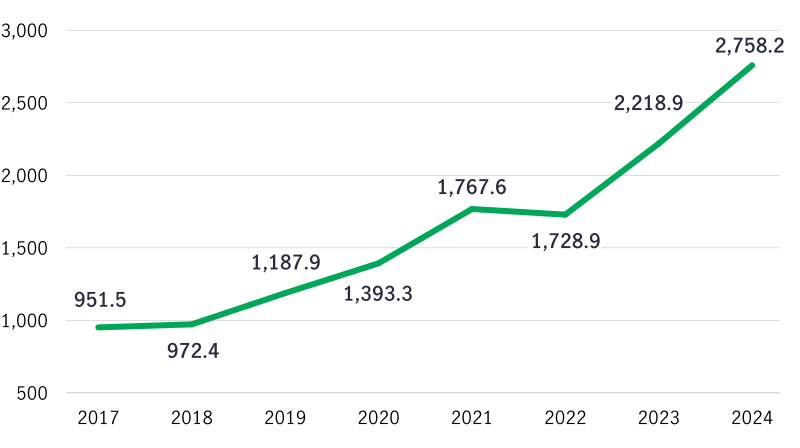
Source: The Cerulli Edge, U.S. Managed Accounts Edition, 2025.
Benefits of SMAs
- Flexibility—SMAs have more flexibility than mutual funds or ETFs because SMAs aren't governed by a prospectus. Typically, a prospectus limits a fund’s strategy to operating within certain guidelines. For example, mutual funds have restrictions on how much of a company’s shares they can own and must meet certain security and sector-exposure requirements to be considered diversified. SMAs are different in that they can have far fewer holdings than a fund and investors can modify an off-the-shelf strategy to suit their needs. While SMAs aren't governed by prospectus, the registered investment advisors who offer them are required to provide investors with an ADV brochure (named after the Securities and Exchange Commission's Form ADV) that outlines information about the advisory firm, fees, services, and the like.
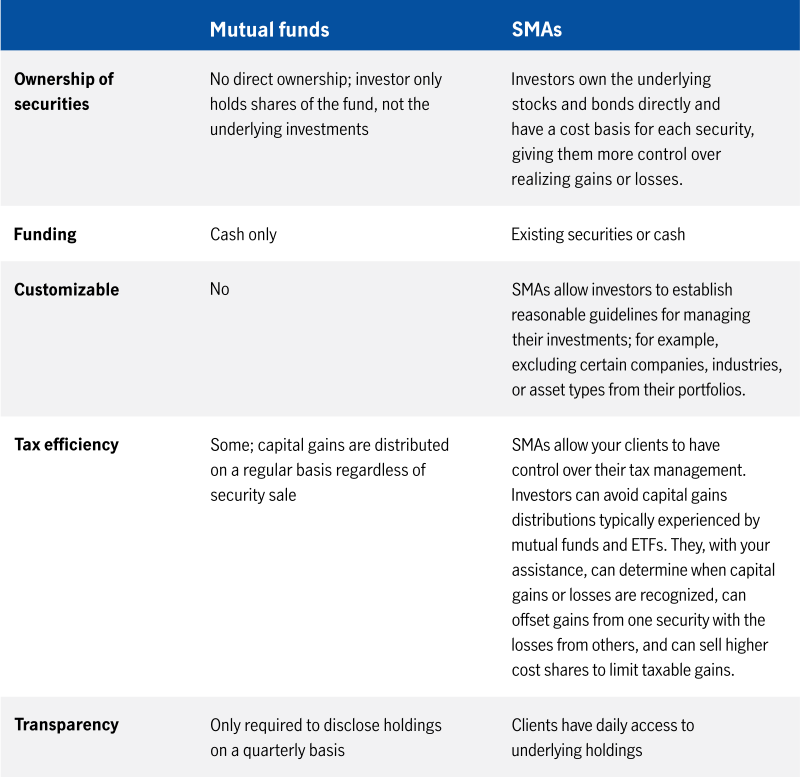
- Tax efficiency—Mutual funds are required to pay out net capital gains and accrued income at least once a year, and outside of qualified retirement accounts, those distributions are taxable. Because mutual fund investors own shares in the fund and not the underlying securities, they have little say in how those distributions are managed or when they take place. And because those distributions often take place with a lag, investors can buy mutual fund shares after a price decline, thinking they got a bargain only to receive a capital gain distribution resulting from the prior year’s activity. SMA investors, by way of contrast, own the underlying securities directly, so they can work with the asset manager to potentially control and help minimize the distribution of taxable gains—for example by offset gains in one area through tax-loss selling. SMAs may also make in-kind exchanges and deploy other strategies that may help limit an investor’s tax liability.
- Transparency—Mutual funds are required to list their complete holdings each month on a publicly available website, but these listings typically post after a delay of 30 to 60 days, with a fund’s 10-largest holdings displayed sooner. ETFs are required to list holdings daily. Because SMA investors own the underlying portfolio holdings directly, they can view those positions at any time. SMAs also typically detail fees and performance separately on a quarterly basis, offering a clear view of the investment’s ongoing expense.
- Lower fees—Fees are generally lower for SMAs than for actively managed mutual funds, in part because SMAs aren't responsible for all the regulatory reporting and administration associated with funds. How much lower? According to Cerulli Associates, SMA management fees range from 0.21% to 0.46%, with a median fee of 0.22% for fixed-income SMAs and 0.37% for equity SMAs. This compares to an average fee of 0.52% for an actively managed mutual fund. It’s important to remember that a financial professional’s fee will be added to the management fee of the underlying investment.1
Separately managed account vs. mutual fund
Limitations of SMAs
- High minimum investment—At this point, you may be wondering why you’d ever invest in anything other than an SMA. The price of entry is a big reason why. SMAs typically require a minimum investment of at least $50,000 and these minimums are often as high as $5 million. For smaller SMA accounts, especially those with a significant number of individual stock holdings, it’s important to note that position sizes can lead to unique challenges. If the account’s value is relatively low and includes high-priced stocks, you may end up holding only a single share of certain companies. This happens when the dollar allocation for a position is small compared to the stock’s price, making it impossible to purchase more than one share. As a result, diversification and customization may be limited for smaller accounts.
- Fewer available options—Despite the pickup in investor interest in recent years, SMAs constitute a smaller universe of options than mutual funds and ETFs. That means that even if you like the concept of an SMA and can afford the minimum investment, it may still be challenging to find the right fit for your needs. In addition, it can be challenging to compare SMAs from different advisors. This is because SMAs often have unique investment approaches, fee structures, and levels of customization that aren’t standardized across firms. Unlike mutual funds and ETFs, which follow clear industry standards and disclosure requirements, SMAs can vary widely in how they’re managed and priced, making it tough to comparison shop and evaluate which option is best for you.
An SMA can be an appropriate solution for an investor who's looking for a more tailored approach and has the capital to invest. Your financial professional can help determine whether an SMA is right for you, help you navigate the available options, and help you take the next step.
1 The Cerulli Edge, U.S. Managed Accounts Edition, 2025. The fees mentioned here are single-contract SMA fees.
Important disclosures
Important disclosures
This material is for informational purposes only and is not intended to be, nor shall it be interpreted or construed as, a recommendation or providing advice, impartial or otherwise. John Hancock Investment Management and our representatives and affiliates may receive compensation derived from the sale of and/or from any investment made in our products and services.
The views presented are those of the author(s) and are subject to change. No forecasts are guaranteed. This commentary is provided for informational purposes only and is not an endorsement of any security, mutual fund, sector, or index. Past performance does not guarantee future results.
Diversification does not guarantee a profit or eliminate the risk of a loss.
SMAs are intended for HNW, investment-savvy individuals and may not be appropriate for all investors.
5251134