










Why active management can matter in municipal bonds
Municipal bonds may look straightforward on the surface, but small differences across issuers, structures, and trading conditions can lead to big differences in pricing and performance. We take a closer look at why active managers may be able to provide an advantage in this asset class.




Municipal bonds remain a compelling source of tax-advantaged income, but the muni market is also characterized by inefficiencies. Its fragmented structure, uneven liquidity, and inconsistent credit visibility can create pricing gaps that don’t fully reflect fundamentals. In our view, that complexity creates opportunities for active managers to add value through rigorous, bottom-up research.
Active muni funds have tended to outperform passive peers
Ten-year rolling returns (%)
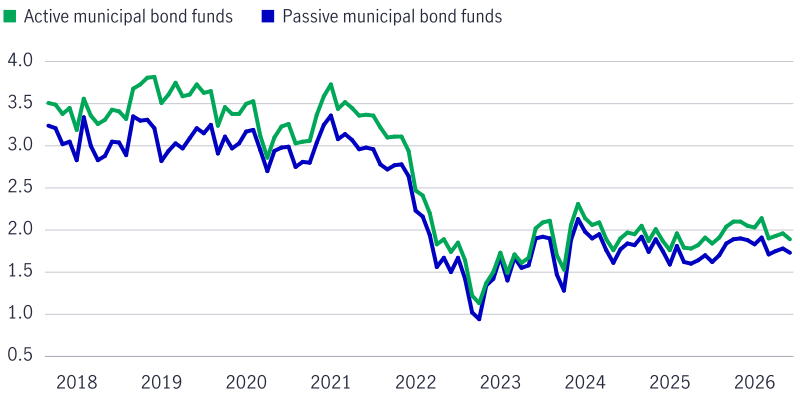
Looking at 10-year rolling returns since 2018 shows that active strategies have tended to outperform their passive counterparts, highlighting how security selection, credit research, and trading execution can add value over a full market cycle.
Five reasons active management may add value in the muni market
1 Seasonality can create short-term dislocations
Municipal bond supply and demand often shift throughout the year. Issuance frequently increases in the spring, while demand may soften as some investors raise cash for tax payments. Even if issuer fundamentals are unchanged, when bonds hit the market at the same time buyer appetite fades, prices can drop, and yields can rise. That’s where active managers, positioned to leverage resources to respond to these calendar-driven moves, may be helpful.
2 The muni market is largely over-the-counter—and liquidity can be uneven
Most munis trade over the counter through dealers rather than on a centralized exchange. With dealer inventories generally lower in recent years, liquidity can be less consistent, especially during volatile periods. When bonds are harder to source and trading is thinner, price differences can persist longer. This can create potential relative value opportunities, but it also underscores the importance of trading expertise and execution.
3 Changes in the buyer base can move pricing
Different investor types concentrate in different parts of the muni market and often operate under constraints (ratings minimums, sector limits, structure restrictions, maturity preferences). For example, the growth of separately managed accounts has increased demand for shorter maturities, while other mandates may avoid bonds below BBB or certain structures and sectors. When demand is strong in some segments and limited in others, prices may reflect buyer constraints as much as credit quality, creating opportunities for active managers to identify mispricing.
4 Many issuers receive limited analyst coverage
With roughly 60,000 municipal issuers, comprehensive credit coverage is difficult, particularly outside the largest and most frequently traded names. When research coverage is limited, new information may take longer to be reflected in market pricing. In our view, this can contribute to wider valuation gaps, especially among smaller or less well-known issuers, reinforcing the potential value of dedicated credit research.
5 Bond structures can make "similar" munis hard to compare
Munis commonly include features such as higher coupons and call provisions that can change how they react to interest rate movements. A 15-year bond may trade more like a shorter bond if it’s callable and investors expect earlier redemption. This happens because the market typically prices the bond to its call date and focuses on yield-to-call and the cash flows investors expect to receive, reducing the bond’s effective duration and interest rate sensitivity even though the final maturity is 15 years. If market participants don’t fully account for structure and call risk, two similar-looking munis can be priced very differently. Active managers may be better equipped to evaluate these nuances and identify relative value that broad, passive exposure can miss.
The advisor takeaway
Municipal bonds offer potential after-tax income benefits, but they’re not a one-size-fits-all market. Seasonality, over-the-counter trading, shifting buyer constraints, limited credit visibility, and structural complexity can all contribute to pricing inefficiencies. Active management provides a disciplined, research-driven approach to navigating these dynamics, with the ability to identify and capitalize on relative value opportunities that may be overlooked in a passive framework.
Important disclosures
Important disclosures
This material is for informational purposes only and is not intended to be, nor shall it be interpreted or construed as, a recommendation or providing advice, impartial or otherwise. John Hancock Investment Management and our representatives and affiliates may receive compensation derived from the sale of and/or from any investment made in our products and services.
The opinions expressed are those of the author(s) and are subject to change as market and other conditions warrant. No forecasts are guaranteed. Past performance does not guarantee future results. This commentary is provided for informational purposes only and is not an endorsement of any security, mutual fund, sector, or index.
This material does not constitute tax, legal, or accounting advice, and neither John Hancock nor any of its agents, employees, or registered representatives are in the business of offering such advice. It was not intended or written for use, and cannot be used, by any taxpayer for the purpose of avoiding any IRS penalty. It was written to support the marketing of the transactions or topics it addresses. Anyone interested in these transactions or topics should seek advice based on their particular circumstances from independent professional advisors.
Investing involves risks, including the potential loss of principal. These products carry many individual risks, including some that are unique to each fund. Fixed-income investments are subject to interest-rate and credit risk; their value will normally decline as interest rates rise or if an issuer is unable or unwilling to make principal or interest payments. Investments in higher-yielding, lower-rated securities include a higher risk of default.
Ratings are from Moody's, if available, and from Standard & Poor's or Fitch, respectively, if not. When not available, internal ratings provided by the subadvisor are used. Ratings composition will change. Individual bonds are rated by the creditworthiness of their issuers; these ratings do not apply to the fund or its shares. U.S. government and agency obligations are backed by the full faith and credit of the U.S. government. All other bonds are rated on a scale from AAA (extremely strong financial security characteristics) down to CCC and below (having a very high degree of speculative characteristics). "Short-term investments and other," if applicable, may include security or portfolio receivables, payables, and certain derivatives.
MF5769235
JHS-972212-2026-07-21