









Tax-equivalent yield: an apples-to-apples way to compare taxable and tax-advantaged income
When investors compare income-producing investments, yield is often the first metric they look at. But yield comparisons can be misleading when two income streams are taxed differently. Tax-equivalent yield helps translate tax-advantaged income into a taxable equivalent, allowing investors to make a more meaningful comparison.


What is tax-equivalent yield?
Tax‑equivalent yield is the pretax yield a taxable investment would need to generate to match the after‑tax yield of a comparable tax‑advantaged investment. In other words, it translates a tax-advantaged yield into a taxable yield, helping investors compare options on a level playing field.
This concept can apply to several types of investments, including municipal bonds and preferred securities. Whenever an investment’s income is taxed differently than a taxable alternative, tax-equivalent yield may help investors avoid misleading yield comparisons.
Why is tax-equivalent yield important for investors to understand?
Tax-equivalent yield is a useful metric because most investors spend after-tax dollars. If two investments have similar risk and maturity characteristics but different tax treatment, the one with more favorable after-tax outcome may not be the one with the higher yield.
Tax-equivalent yield can help investors answer questions like:
- How much higher would a taxable yield need to be for its after-tax yield to exceed that of a tax-advantaged investment?
- How does this lower-yielding option compare once taxes are considered?
- Which investment is more tax-efficient for this account and this taxpayer?”
This measure can be especially impactful for higher-income households, where marginal rates may materially reduce the after-tax yield from taxable income.
How do you calculate tax-equivalent yield?
The following formula shows how to calculate tax-equivalent yield on a tax-exempt bond, where x represents an investor’s federal income tax bracket.
Tax equivalent yield = Yield of tax-exempt bond % / (1-x)
For example, comparing a taxable bond with a 4.20% yield to a tax-exempt bond of 3.50% for an investor in the 22% federal tax bracket, where x = 0.22, the tax-equivalent yield is calculated as
Tax-equivalent yield = 3.50% / (1-0.22) = 4.49%
In this case, the tax-equivalent yield of a tax-exempt bond with a yield of 3.50% is 4.49%, which is higher than the 4.20% yield of the taxable bond.
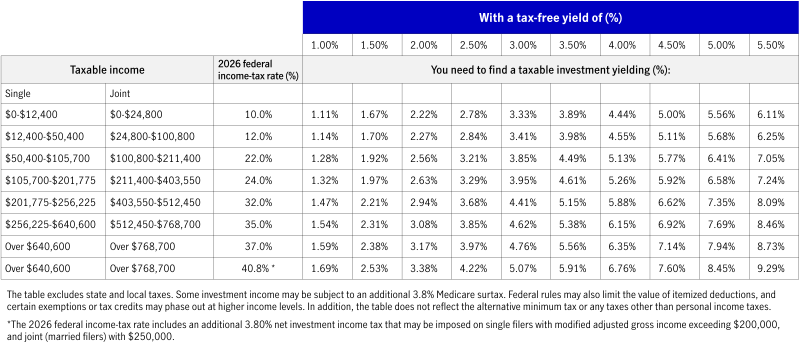
Thinking beyond this specific example, the key takeaway is that as an investor’s tax rate rises, the tax-equivalent yield rises as well, meaning a taxable investment needs to offer a meaningfully higher yield to be competitive.
Tax rates' impact on tax-equivalent yield
Tax-equivalent yield by marginal tax bracket
Does tax-equivalent yield include state taxes?
Many municipal bond interest payments are exempt from federal income tax. Some municipal bond interest may also be exempt from state, and occasionally local, taxes—but not all munis are exempt from all three.
Two practical rules of thumb:
- Out-of-state municipal bonds are often not exempt from your home state’s income tax, even if they’re federally tax-exempt.
- In-state municipal bonds may be exempt from both federal and state income taxes for residents of that state, depending on the bond and the investor’s situation.
This is one reason state-specific muni strategies can resonate in high-tax states, where high-income investors may see a substantial portion of taxable bond income consumed by taxes. Tax-advantaged investments such as municipal bonds can help these investors retain more of their earnings, making them an attractive option for helping preserve after-tax income.
The advantage of municipal bonds in high-tax states
Taxes paid and income kept on a hypothetical $100,000 investment yielding
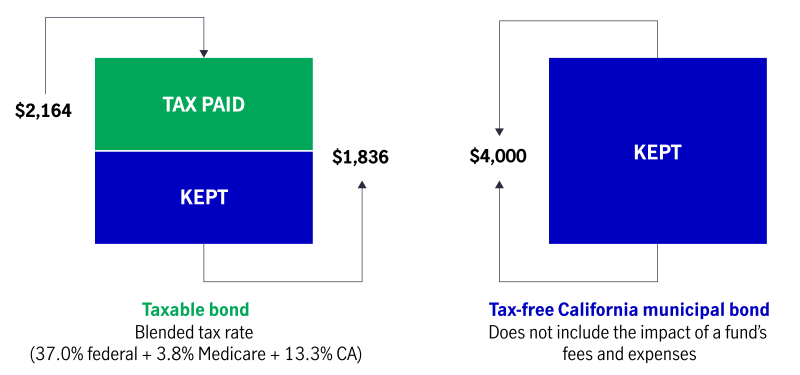
When calculating tax-equivalent yield, investors should understand which taxes may apply to a given investment and use the appropriate tax rates to ensure they're making an accurate comparison.
When should investors consider tax-equivalent yield?
Importantly, tax-equivalent yield tends to be very useful for investors holding investments in taxable accounts. This includes taxable brokerage accounts, trusts, and other accounts where current income is taxed annually.
The calculation is generally less useful, or possibly irrelevant, in tax-deferred and tax-free accounts such as traditional IRAs, 401(k)s, or Roth IRAs. The measure should also not be used when the investments being compared differ significantly in risk, since it doesn’t adjust for factors such as credit risk, liquidity risk, call risk, or interest rate sensitivity.
The bottom line for investors
Tax-equivalent yield can be a valuable tool for comparing income-producing investments when tax treatment differs, such as municipal bond investors in higher tax brackets or high-tax states. By converting a tax-advantaged yield into a taxable equivalent, tax-equivalent yield can help investors make apples-to-apples comparisons and better evaluate after-tax income potential.
Because tax rules and individual circumstances can vary, including federal, state, and local considerations, investors should consider tax-equivalent yield alongside other factors such as risk, liquidity, and time horizon, and consult with their financial and/or tax professional before making investment decisions.
To learn more about comparing taxable and tax-advantaged investments, please see our flyer on understanding tax-equivalent yield.
Important disclosures
Important disclosures
This material is for informational purposes only and is not intended to be, nor shall it be interpreted or construed as, a recommendation or providing advice, impartial or otherwise. John Hancock Investment Management and our representatives and affiliates may receive compensation derived from the sale of and/or from any investment made in our products and services.
The opinions expressed are those of the author(s) and are subject to change as market and other conditions warrant. No forecasts are guaranteed. Past performance does not guarantee future results. This commentary is provided for informational purposes only and is not an endorsement of any security, mutual fund, sector, or index.
This material does not constitute tax, legal, or accounting advice, and neither John Hancock nor any of its agents, employees, or registered representatives are in the business of offering such advice. It was not intended or written for use, and cannot be used, by any taxpayer for the purpose of avoiding any IRS penalty. It was written to support the marketing of the transactions or topics it addresses. Anyone interested in these transactions or topics should seek advice based on their particular circumstances from independent professional advisors.
Investing involves risks, including the potential loss of principal. These products carry many individual risks, including some that are unique to each fund. Fixed-income investments are subject to interest-rate and credit risk; their value will normally decline as interest rates rise or if an issuer is unable or unwilling to make principal or interest payments. Investments in higher-yielding, lower-rated securities include a higher risk of default.
MF5345738
JHS-908257-2026-03-27