









Qualified dividend income: a key benefit for preferred securities investors
For investors seeking tax-advantaged income, understanding qualified dividend income is essential. We explore how QDI can benefit investors in preferred securities, enhancing after-tax yields.


What is qualified dividend income?
Qualified dividend income (QDI) is dividend income that meets IRS requirements and is taxed at preferential long-term capital gains rates (0%, 15%, or 20%) instead of ordinary income tax rates (up to 37%). For many investors, qualified dividends can help keep more of their investment earnings in their pocket at tax time. Not all dividends qualify, so it’s essential to know which investments offer this potential tax advantage.
Do preferred securities pay qualified dividends?
Preferred securities are an area where investors can potentially benefit from this favorable tax treatment. Some preferred share dividends from U.S. companies are generally eligible to be classified as QDI, which means they may be taxed at lower rates. However, there are exceptions: dividends from real estate investment trusts (REITs), certain foreign companies, and some financial institutions don't typically qualify.
How is qualified dividend income taxed?
QDI is taxed at preferential rates, ranging from 0% to 20%, determined by income bracket and the investment holding period. These rates are generally more favorable than the ordinary income tax rate, which can reach up to 37% depending on an investor’s income level.
QDI is taxed at preferential rates relative to interest income
Taxes paid and income kept on a hypothetical $100,000 investment yielding 5%
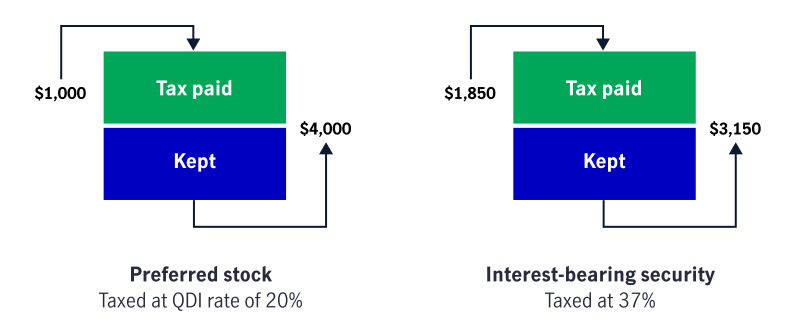
This means investors can keep more of their earnings from qualified dividends compared to other types of income. For those aiming to maximize after-tax returns, preferred securities that pay QDI can be an attractive option for generating tax-advantaged income.
Why now might be the time to consider an allocation to preferred securities
For income-seeking investors, preferred securities are worth considering in today’s uncertain economic environment. Qualified dividend income (QDI) from preferreds allows investors to keep more of their earnings. This could be a valuable benefit if yields continue to decline, as the steady income from this asset class can provide stability and help offset lower yields from other sources.
Preferred securities are also often issued by high-quality companies and financial institutions, making them well-positioned to withstand an economic slowdown or recession. With over 82% of the preferred securities market rated investment grade, this defensive quality has the potential to help cushion your portfolio during periods of market volatility.1
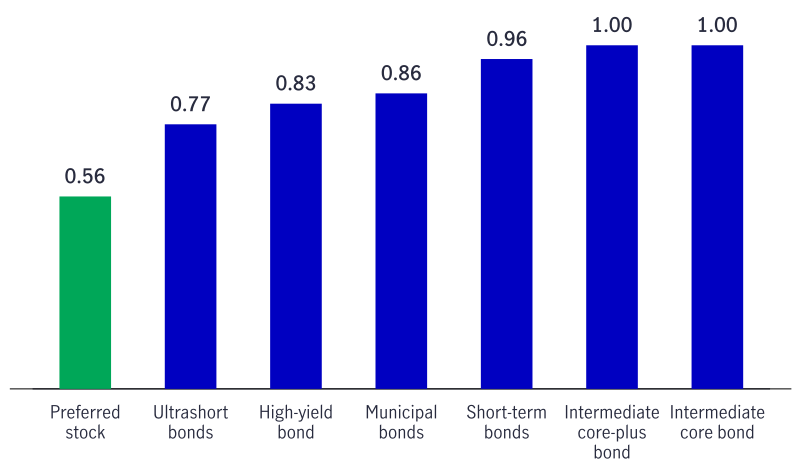
Another key benefit of preferred securities is their ability to provide diversification benefits to your fixed-income portfolio. As hybrid securities with characteristics of both stocks and bonds, preferred securities have historically exhibited a low correlation with the broad bond market. This makes them a valuable complement to your core or core-plus bond allocation and can potentially enhance your portfolio’s risk-adjusted returns.
Preferreds have a lower correlation to the broad bond market
3-year correlation to the Bloomberg U.S. Aggregate Bond Index
Unlocking the full potential of preferreds with active management
We strongly believe that active management can play a crucial role in investing in preferred securities. Unlike passive strategies, active managers can adapt to changing market conditions, adjust sector exposures, and select securities from across the capital structure.
One way management teams can add value is by managing the portfolio’s duration, adjusting interest rate sensitivity by investing across different areas of the preferreds market. For example, when inflation is easing and rates are expected to fall, managers may favor institutional preferred stocks with fixed-rate coupons.
These securities typically offer higher yields than common stocks and many traditional bonds, helping investors lock in attractive income and reduce reinvestment risk. As rates decline, the value of fixed-rate preferreds often rises, providing potential for both steady income and price appreciation and making them an appealing choice in a falling rate environment.
When inflation is rising, preferred securities with a fixed-to-floating rate structure, such as junior subordinated debt, can provide valuable flexibility. After an initial fixed-rate period, these securities adjust their coupon payments upward in line with prevailing interest rates, helping investors capture higher income as rates rise. This adaptability makes fixed-to-floating rate preferreds an appealing option when the outlook calls for higher rates.
By actively investing across the breadth of the preferreds market, skilled managers can potentially mitigate risk and seek out the most attractive opportunities. This hands-on approach creates an opportunity to enhance returns and provide stability, especially during periods of market volatility.
1 Bloomberg, as of September 30, 2025.
Important disclosures
Important disclosures
Investing involves risks, including the potential loss of principal. There is no guarantee that a fund’s investment strategy will be successful. Fixed-income investments are subject to interest-rate and credit risk; their value will normally decline as interest rates rise or if an issuer is unable or unwilling to make principal or interest payments. Preferred stock dividends are payable only if declared by the issuer’s board. Preferred stock may be subject to redemption provisions. Investments in higher-yielding, lower-rated securities involve additional risks as these securities include a higher risk of default and loss of principal. REITs may decline in value, just like direct ownership of real estate. Foreign investing, especially in emerging markets, has additional risks, such as currency and market volatility and political and social instability. The use of hedging and derivatives could produce disproportionate gains or losses and may increase costs. It’s possible that an active trading market for fund shares will not develop, which may hurt your ability to buy or sell fund shares, particularly in times of market stress. Trading securities actively can increase transaction costs, therefore lowering performance and taxable distributions. Liquidity—the extent to which a security may be sold or a derivative position closed without negatively affecting its market value, if at all—may be impaired by reduced trading volume, heightened volatility, rising interest rates, and other market conditions. A portfolio concentrated in one industry or sector that holds a limited number of securities may fluctuate more than a diversified portfolio. Fund distributions generally depend on income from underlying investments and may vary or cease altogether in the future. Shares may trade at a premium or discount to their NAV in the secondary market. These variations may be greater when markets are volatile or subject to unusual conditions. Please see the fund’s prospectus for additional risks.
The views presented are those of the author(s) and are subject to change. There is no guarantee that any investment strategy illustrated will be successful or achieve any particular level of results. This is for informational purposes only and is not intended to be, nor shall it be interpreted or construed as, a recommendation or providing advice, impartial or otherwise, regarding any security, mutual fund, ETF, sector, or index. Investors should consult with their financial professional before making any investment decisions. Past performance does not guarantee future results.
JHS-887721-2026-02-17