











Active ETFs. Made for how you build portfolios.
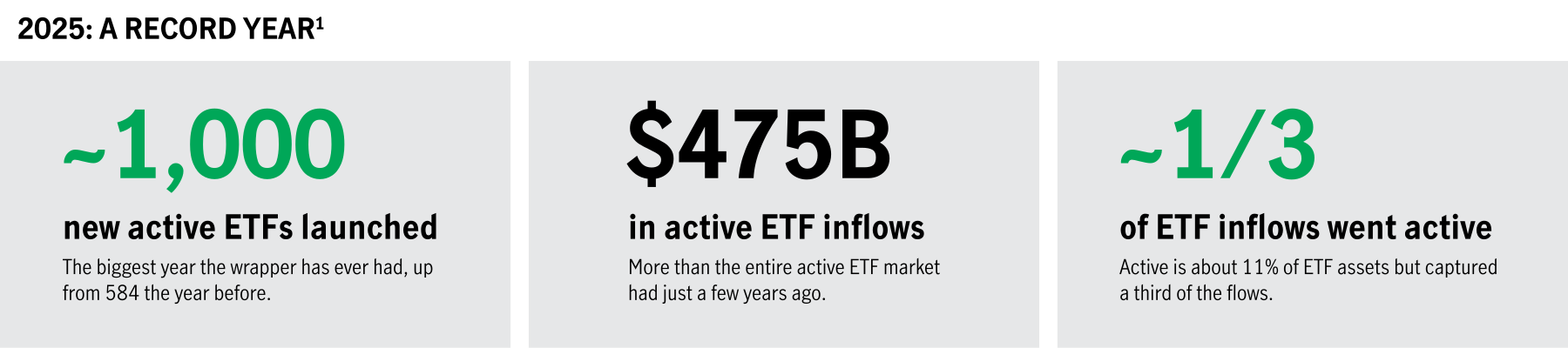
There are more active ETFs to choose from than ever before. Learn what's behind this trend and what it could mean for portfolio construction.

Why advisors keep leaning in—and what to ask before you allocate
ETFs have become an increasingly popular vehicle for active investment strategies and may offer features such as competitive costs, intraday liquidity, and potential tax efficiencies for taxable investors. The relevance and impact of these features will vary based on the underlying strategy, market conditions, portfolio activity, and individual investor circumstances. Here's what to keep in mind.
COST
Look past the expense ratio.
ETFs avoid sales loads and 12b-1 fees, but bid/ask spreads are a real cost. Niche, illiquid, or low-volume strategies trade wider. Ask issuers what they do to tighten spreads.
TAX
In-kind isn't automatic.
Only 6% of U.S. ETFs distributed capital gains in 2025,4 but turnover, concentration, AUM, and cash-vs-in-kind redemptions all move the needle on any single fund.
TRANSPARENCY
Visibility can put active management into context.
Transparency can help investors better understand how an active strategy is positioned and managed. That visibility may make a strategy easier to evaluate and incorporate into a broader portfolio.
Explore our lineup of active ETFs
Active investing starts with experienced managers and a distinct point of view. Our multimanager approach combines in-house investment capabilities with the specialized expertise of select subadvisors, offering active ETF options that provide access to differentiated insights, portfolio construction expertise, and a wide range of investment opportunities.
FIXED INCOME
| Ticker | Fund/Manager | Investment objective |
|
Manulife Investment Management |
Targets high-quality core income opportunities |
|
|
Manulife Investment Management |
Aims to diversify core income holdings |
|
|
Manulife Investment Management |
Provides investment-grade credit exposure |
|
Mortgage-Backed Securities ETF Manulife Investment Management |
Pursues securitized income with a rate-aware approach |
|
|
Manulife Investment Management |
Seeks tax-exempt income using a dynamic approach |
|
|
CVC Marathon |
Targets higher income where passive tends to lag |
|
|
Manulife | CQS Investment Management |
Pursues floating-rate income and rate-sensitivity relief |
|
|
Manulife Investment Management |
Seeks tax-advantaged income from quality issuers |
EQUITY
| Ticker | Fund/Manager | Investment Objective |
|
Boston Partners |
Provides core large-cap value exposure |
|
Disciplined Value International Select ETF Boston Partners |
Provides core international value exposure |
|
|
Manulife Investment Management |
Targets quality U.S. dividend payers |
|
International High Dividend ETF Manulife Investment Management |
Focuses on dividend income outside the U.S. |
|
|
Manulife Investment Management |
Provides high-conviction large-cap exposure |
|
|
Manulife Investment Management |
Pursues an all-cap core approach built on bottom-up research |
|
|
Manulife Investment Management |
Provides equity participation while targeting lower volatility relative to the market |
To see our full ETF lineup, including our factor-based ETFs, click here.
Fundamental All Cap Core ETF: This ETF is different from traditional ETFs. Traditional ETFs tell the public what assets they hold each day. This ETF will not. This may create additional risks for your investment. For example: You may have to pay more money to trade the ETF's shares. This ETF will provide less information to traders, who tend to charge more for trades when they have less information. The price you pay to buy ETF shares on an exchange may not match the value of the ETF's portfolio. The same is true when you sell shares. These price differences may be greater for this ETF compared to other ETFs because it provides less information to traders. These additional risks may be even greater in bad or uncertain market conditions. The ETF will publish on its website each day a “Tracking Basket” designed to help trading in shares of the ETF. While the Tracking Basket includes some of the ETF's holdings, it is not the ETF's actual portfolio. The differences between this ETF and other ETFs may also have advantages. By keeping certain information about the ETF secret, this ETF may face less risk that other traders can predict or copy its investment strategy. This may improve the ETF's performance. If other traders are able to copy or predict the ETF's investment strategy, however, this may hurt the ETF's performance. For additional information please refer to the fund's prospectus and/or statement of additional information.

Want the full framework?
Read our white paper, Developing a framework for active ETF due diligence, or talk with your Manulife John Hancock Investments ETF specialist.
Important disclosures
Important disclosures
1 “Active ETFs: 9 Charts on a Record Year,” Morningstar, 1/15/26. 2 “U.S. Exchange-Traded Fund Markets 2025,” Cerulli Associates, 2025. 3 "The Global ETF Survey 2025,” Trackinsight, 2025; 4 “Few ETFs Project Capital Gains Distributions in 2025,” Morningstar, 12/11/25.
Lineup reflects actively managed John Hancock ETFs and excludes index-based multifactor ETFs subadvised by Dimensional Fund Advisors LP.
Investing involves risks, including the potential loss of principal. These products carry many individual risks, including some that are unique to each fund. Please see each fund’s prospectus to learn all of the risks associated with each investment.
This material does not constitute tax, legal, or accounting advice, is for informational purposes only and is not meant as investment advice. Please consult your tax or financial professional before making any investment decisions.
It is important to note that there are material differences between investing in an ETF versus a mutual fund. ETFs trade on the major stock exchanges at any time during the day. Prices fluctuate throughout the day like stocks. ETFs generally have lower operating expenses, no investment minimums, are tax efficient, have no sales loads, and have brokerage commissions.
Mutual funds trade at closing NAV when shares are priced once a day after the markets close. Operating expenses may vary. Most mutual funds have investment minimums and are less tax efficient than ETFs; many mutual funds have sales charges and they have no brokerage commissions.